


In this article
View 3 More +When we have cats, they talk to us constantly with different vocalizations. We can tell a lot about a cat’s mood by how they use their body language and vocal repertoire.
In this article, we will explore how cats communicate with us and how we can better understand them. This will help our relationships flourish, creating a mutually beneficial scenario for both parties. The more you can understand your cat, the better off you’ll be.

Understanding Cat Vocalizations
Before you can learn how to talk to a cat, you first have to understand how cats communicate. Our cats have a multitude of ways to communicate with others. They have actions to convey emotion all throughout the spectrum, ranging from positive to negative. Below are some cat vocalizations, along with what they mean. Understanding each one will help you identify what kind of mood your cat is in and what they could be trying to convey to you.
Meowing
Everyone has heard a cat meow. It’s one of the most common vocalizations they produce and it can be used in a variety of contexts. Cats can meow when they are both happy or trying to get your attention, so it’s important to take note of other body language cues to see what kind of mood your cat is in.
For example, they might give you a happy meow upon your arrival home after a long day. Or you might still need to fill the food bowl, and they are demanding their dinner with an angry meow.

Purring
We often correlate purring with being completely content or happy. That is the case in a majority of situations. However, cats also purr when they are injured, unwell, or even close to death. It has been suggested that purring during some of these situations might be a way for them to signal that they are not a threat.
Chirp/Trill/Chirrup
The chirp, trill, or chirrup is often a greeting reserved for their people and used in kitten-mother interactions. It’s a long, drawn-out mix between a meow and a purr, creating a rolling R that many other languages are likely impressed by!
Chatter
If you have ever heard a chatter, you might wonder, “What on earth is wrong with that cat?” They are in the zone; they are fierce; they are ready. They want to sink their teeth into that bird on the ledge so bad they can taste it. They want to prey upon the innocent chipmunk in the tree, but they can’t.
So, chattering is often thought to be a sign of pent-up predatory frustration. We’ve all heard chattering, even if it wasn’t firsthand. All the funny cat videos on the Internet incorporate chattering of some kind. After all, it is quite hilarious when you hear a cat make this vocalization.

Yowling
Yowling is a painful sound—a loud, obnoxiously nasally meow that goes on for days. Often, this is reserved for cats in heat looking for a mate, but it can also be used to express illness, attention seeking, loneliness, or stress.

Body Language Cues
Often, vocalizations can be used for a variety of situations, but cats can also communicate with their body language. Sometimes a cat’s body language means business, other times, they’re being cheerful, and sometimes, they’re plain disgruntled. So how do you know? We have the details!
Tail

- Tail Twitching: Tail twitching typically means your cat is being anxious or watchful. For example, if there is a predator or potential pest nearby, your cat might start flicking their tail and watching the behavior of this other animal very intently.
- Tail Fur Sticking Up: Sometimes, when cats get freaked out, the hair on their back stands straight up. You can think of a classic Halloween cat when you see this. A cat in this stance may be ready to attack, so never approach them directly. If you have spooked them, just give them their time to calm down before attempting to interact.
- Tail Tucked, Hunched: If your cat is tucking their tail and running for cover, something is probably happening in their surroundings that has scared them into seclusion. The best thing you can do in this scenario is give your cat the space they need until they’re ready to interact.
- Tail Straight Up and Curled at the End: If the tail is standing perky and curled slightly at the end, whatever is going on? Typically, this is what they do when they are content and curious about their surroundings.
- Tail Stand Straight, But Low: If you see a cat’s tail is completely straight but curled downward, this can signal extreme aggression and could mean a fight is in place, depending on the surroundings. Other vocalizations like hissing and growling usually accompany this.
Eyes
A cat’s eyes can tell all, just like nearly any living creature. So, our eyes can give us a very good indication of mood based on the pupils and positioning.

- Dilated Pupils: Dilated pupils can signal one of two things. Either it means that they are excited about something, or they are fixated on prey.
- Squinted Glare: This usually happens when your cat is relaxed and isn’t generally amused about what’s happening. They aren’t aggravated quite enough to be overly displaying it, but they are fully aware that the energy around them does not match their mood.
- Slow Blinking: Slow blinking is often a sign of affection, and it’s generally seen when you are paying attention to your cat.
Head
Let’s not forget the feline head—one of the parts that has the most personality! What do expressions or movements of the head mean? Let’s find out!
- Bunting:Bunting is often done during affection sessions. However, this is a territorial behavior, so essentially your cats are claiming you as theirs! They are bunting you to rub the pheromones produced in their glands on you, letting other cats know whose property you are.
- Rubbing: Cats like to rub up against you because it simply feels good and because it’s a way of transferring their scent.
- Face Sniffing: Face sniffing is a direct and up-close way to make sure that you are who they think you are. It is a way to get some more information about your pheromones and other signals your body is letting off through your smell.
- Wet Nose Kiss: If your cat gives you a kiss with their wet nose, it’s simply a way to signal affection. What an adorable way to say “I love you!”
- Licking: Cats get a few different things out of licking. First of all, they get a lot of information about you by detecting your hormones through your skin. They also could be exhibiting grooming behavior, which is a sign of affection, seeing you as one of their own.

Paws
What can the paws say? Their murder mittens can obviously do much damage, but what else?
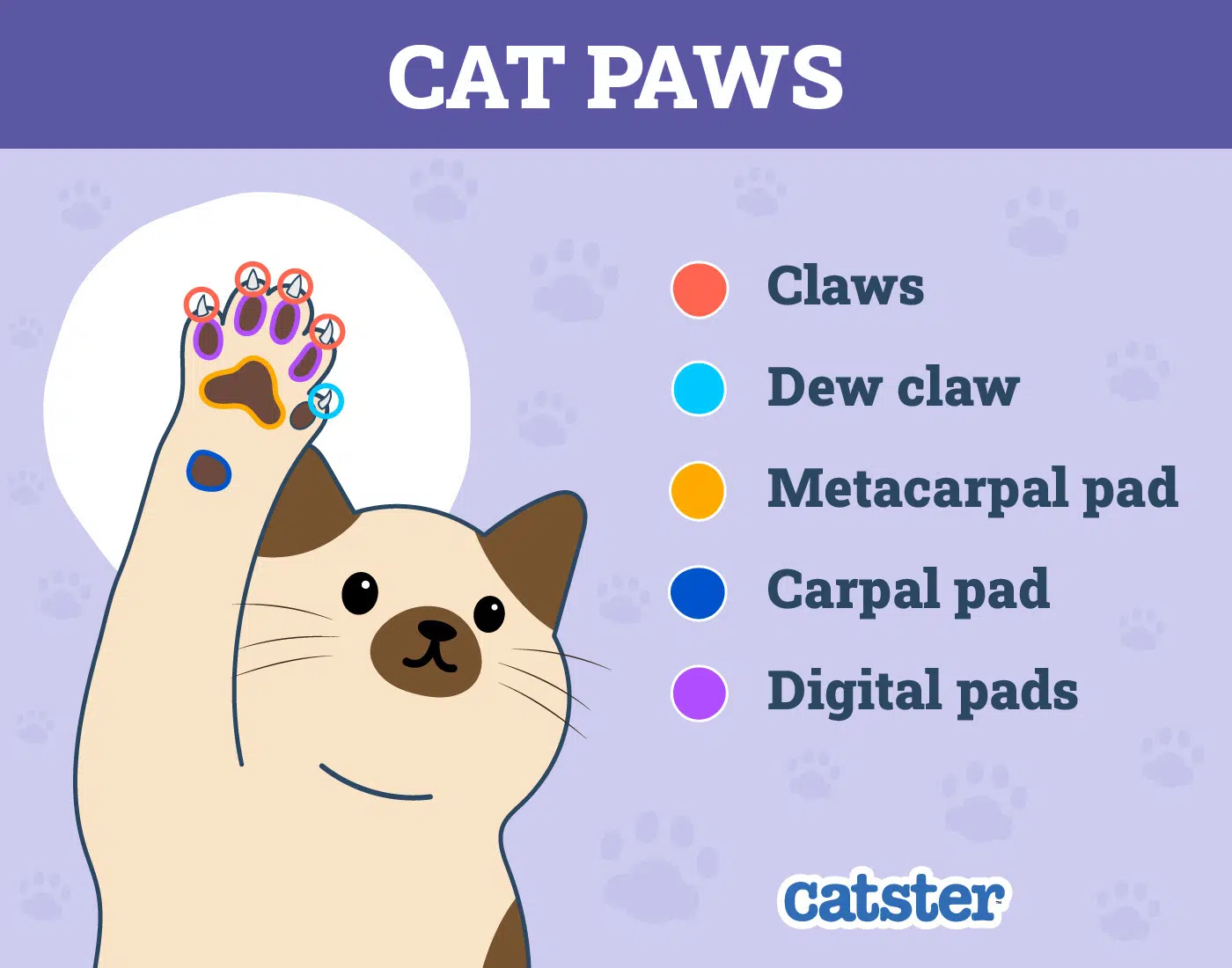
- Kneading: Kneading is often mimicking nursing the mother. So, it should be no surprise that this is a sign of comfort and safety.
- Clawing: Clawing can be aggressive or playful in nature. Sometimes, it says, “Leave me alone!” or it might say, “Hey, let’s play! Can I rip the flesh off your arms?” Both are equally painful.
- Pawing: If your cat tries to grab your hand or put their paw on your body gently, it might be a way to get your attention. If your cat isn’t using their claws, they just want to use their limbs to jar your eyes over to them. It can be a subtle or not-so-subtle attempt for attention.
How to Speak Cat Language and Communicate With Your Cat
Okay, okay. We realize you may not be able to actually talk to your cat the way you can another person. Cat language is not exactly something that can be taught, after all. But that doesn’t mean you can’t communicate with them. Now that you have the basics down of cat vocalizations and body language, we can move on to how you can interact with your pet by understanding these vocal and visual cues.
Does Meowing Do Anything?
You might think the best way to talk back to your cat is to meow with them, but do our cats honestly understand what we’re doing if we meow in response? The answer, with loosely based science, is no. Our cats don’t really recognize our meows as relevant language. We aren’t saying anything that they can even remotely understand. If you meow at your cat and they meow back, it’s likely just in response to the sounds you made in order to reciprocate the vocalization and not the fact that the two of you are actually having a conversation.
So, how can we communicate with our cats in ways that they understand?

Use Familiar Words
Just like dogs, cats can pick up on various words and their meanings. So, don’t be afraid to teach your cat new things. They can learn cues like “come,” “treat,” “bye-bye,” and anything else! Cats can also very quickly pick up on their name.
Understand the Impact of Inflection
You would not believe what an effect your voice has on your relationship with your cat. They can pick up on our moods very easily, whether we are happy, sad, angry, or otherwise. If you say something in a happy tone of voice, your cat can pick up on the inflection and know that you are happy. Likewise, if you say something in a firm tone, your cat can understand that you mean business.
Understand Boundaries
Cats are not like dogs. They are creatures of their own. They want attention when they want attention, and they want peace when they want peace. Living with a cat is about adopting the understanding of mutual respect. Your cat might not be very good at identifying your boundaries, but you can easily understand your cat’s, making you the more mature person in the relationship.
You can respond accordingly by giving your cat their space and understanding when they do and don’t want affection or attention by reading their body language. If you can tell your cat isn’t quite in the mood for your shenanigans, you can adapt to the understanding that you can interact with them another time.

Be Firm
You can’t let your cat walk all over you. You have to stay firm. Cats have a tendency to do what they want; we all know that it’s true. You have to find a way to end that behavior by letting your cat know you’re the boss. That is not to be confused with using elaborate punishments to control them. Rather, you need to let your cat know consistently that you mean business.
Treat Play and Downtime Differently
If you are expecting your cat to understand certain boundaries, you must teach them the difference between play time and downtime. Don’t start antagonizing your cat to chase your hand or get wound up while they are laying down. This can confuse your cat and make them need help understanding the difference between the two points of the day.
Our Favorite Cat Toys Right Now Here are a some of our favorite toys, each catering to a variety of senses and play preferences. Which one will your feline fancy? At Catster, we've admired Hepper for many years, and decided to take a controlling ownership interest so that we could benefit from the outstanding designs of this cool cat company!
Image
Product
Details

Hepper Catnip Mice Toy Set
Check Price

Hepper Furball Set
Check Price
Incorporate Treats
Cats are extremely food-motivated creatures. If you beat them with food, they can’t resist! Try to incorporate treats while you train your cat to captivate their attention. Some cats will prefer certain types of treats over others. You can buy broths, crunchy snacks, soft chews, and several other treat types to satisfy your cat’s taste buds.
Offer Environmental Enrichment
Environmental enrichment can make all the difference in a cat’s happiness. They can communicate in so many ways to let you know they are content, happy, or otherwise bothered, and you can adjust the home setting accordingly.
Make sure your home is a stress-free zone where your cat feels no fear. Make it safe, comfortable, and cat-safe. Fill it with toys, exercise products, cat trees, and puzzles for your cat to enjoy.
The Hepper Hi-Lo Modern Cat Scratcher is a functional and stylish design that makes it the ultimate scratching spot for your cat – and a superhero in the battle against furniture destruction. Unlike most cat toys that end up being ignored, this one's a crowd-pleaser for both cats and their hoomans.
With its 3 configurations, thick textured cardboard, and solid birch plywood frame, it encourages your cat's natural scratching instincts, so they stay away from your precious furniture, rugs, and curtains, among all other things they shouldn't scratch. The Hi-Lo is like your home's mini guardian, keeping it safe while looking super sleek and trendy. At Catster, we’ve admired Hepper for many years, and decided to take a controlling ownership interest, so that we could benefit from the outstanding designs of this cool cat company!
Know When to Let Your Cat Call the Shots
When it comes to how much you interact with your cat via physical affection, such as holding them or petting them, it is important to let them call the shots most of the time. You have the right to assert your boundaries as well, but when it comes to your cat chilling in their own space, you want to make sure it’s a good time to interact before you take it upon yourself to do so.
If your cat doesn’t want to be bothered and you are continually invading their space, it could cause some stress on the relationship.

FAQ About Cat Communication
Do All Cats Vocalize the Same?
If you own cats, you know how different they are from dogs. So, it’s no wonder that our cats have different ways of using their voice to be heard. While cats are usually much quieter than their canine counterparts, some of them can be very chatty. It really just depends on the cat as to how much they vocalize.
Does a Squirt Bottle Do Anything?
You might think that a good way to get your cat to listen would be to squirt them with a squirt bottle. Where we see the line of thinking here, it can also cause fear-based reactions in some cats, negatively impacting your overall relationship with them.
Should You Punish Cats?
You might read some mixed opinions when it comes to punishing cats. Ultimately, the idea is that if you show your cat respect, they will respond accordingly. Some cats can be more challenging than others using intelligence levels and activity needs, but punishment and negative reinforcement are the least effective methods for communicating with your cat. It’s best to stick to positive reinforcement via treats and praise, and don’t give negative behaviors any attention.
Conclusion
So, hopefully after reading this article, you have a better understanding of cats and how they communicate. This can help you understand their actions and respond accordingly. There are plenty of ways you can communicate with your cat—both verbally and non-verbally. Chances are, by understanding the way your cat communicates, you two will have a special relationship nothing can replicate. Think of it as your own language, if you will.
See Also:
- How to Sing to Your Cats (Do They Like It)? Feline Musical Facts
- How Do You Say Cat in Different Languages? Learn How to Say it!
Featured Image Credit: Africa Studio, Shutterstock





